

RECAPRUSH MOVIE GUIDE
Terminator 2: Judgment Day (1991)
Directed by James Cameron
RecapRush examines John’s rule against killing, Sarah’s refusal to execute Dyson and the responsibility behind the final farewell.
Overview, poster, and credits from TMDB.
Read and watch our analysis ↓FROM THE RECAPRUSH LIBRARY · ANALYSIS
Terminator 2 (1991): John’s First Lesson Is When Not to Kill
5 min read · Estimated reading time— views
RecapRush viewpoint · Spoilers for the 1991 film, including its ending.
John Connor inherits a frightening job description: humanity’s future depends on him. Our reading of Terminator 2: Judgment Day is that his most important qualification is the limit he places on a weapon he controls. Saving people requires more than identifying an enemy and becoming powerful enough to eliminate it. John has to decide what his power must never make acceptable.

Quick facts
- Film: Terminator 2: Judgment Day (1991), directed by James Cameron; written by Cameron and William Wisher.
- US opening: July 3, 1991. Runtime: 137 minutes in AFI Silver’s listing; the AFI Catalog lists 135.
- Principal cast: Arnold Schwarzenegger — the Terminator; Linda Hamilton — Sarah Connor; Edward Furlong — John Connor; Robert Patrick — T-1000; Joe Morton — Miles Dyson.
- Identity: TMDB movie 280 · IMDb tt0103064.
- Scope: The 1991 feature’s shared theatrical-story events, without later sequel developments or deleted alternate endings.
John’s rule turns protection into responsibility
When the Terminator threatens men during an encounter, John intervenes and tells it that killing people is unacceptable. The boy’s command changes the terms of being protected.
For us, the significant detail is that obedience gives John an opportunity to become careless. Someone else can perform the violence while he enjoys its benefits. Instead, he accepts responsibility for what his protector does. The film places moral education inside an unequal relationship: the child has authority over a body capable of overwhelming force.
John’s rule does not settle every problem of violence. It establishes that usefulness cannot be the only test. The machine must answer to a standard beyond its immediate objective. That makes John’s emerging leadership less a matter of destiny than a habit of restraint that he chooses to practice.

Sarah has to recognize a person inside a threat
Sarah’s attempt to kill Miles Dyson brings the same problem into a human body. She wounds him but cannot execute him. After John and the Terminator arrive and explain the danger, Dyson agrees to help destroy the Cyberdyne work.
Our interpretation: Sarah’s pause is an achievement of perception. Knowledge of a possible catastrophe can make one present-day person seem disposable. Her mission offers a terrible shortcut: reduce Dyson to the future consequences associated with his research, then remove him.
More from RecapRush
 Severance Season 2 Recap & Ending Explained: Why Mark Chooses Helly Over Gemma
 Chernobyl (2019) Recap & Ending Explained: Why Legasov Chooses Truth Over Survival
 Plastic Beauty (2026) Series Recap & Ending Explained – What Happens to Fumi and Rin?
Refusing that shortcut creates a different possibility. Dyson can become a participant in preventing harm. The film gives cooperation a place that assassination would have erased. Sarah’s preparation for disaster remains understandable; the troubling question is whether preparation has begun to consume the very human distinctions she wants to preserve.

Ending explained: caring makes the necessary loss harder
Cast and Characters
At the steel mill, the T-1000 is destroyed. The remaining dangerous technology must also go, including the protector. John is distraught; the Terminator expresses an understanding of human tears. Sarah lowers it into the molten metal, and it raises a final thumb.
We read this farewell as a test of the rule John began teaching. He wants this particular machine to stay because their relationship matters. The ending makes responsibility painful by refusing to let affection make an exception convenient. Protecting a future extends beyond keeping the person—or machine—you have come to love.
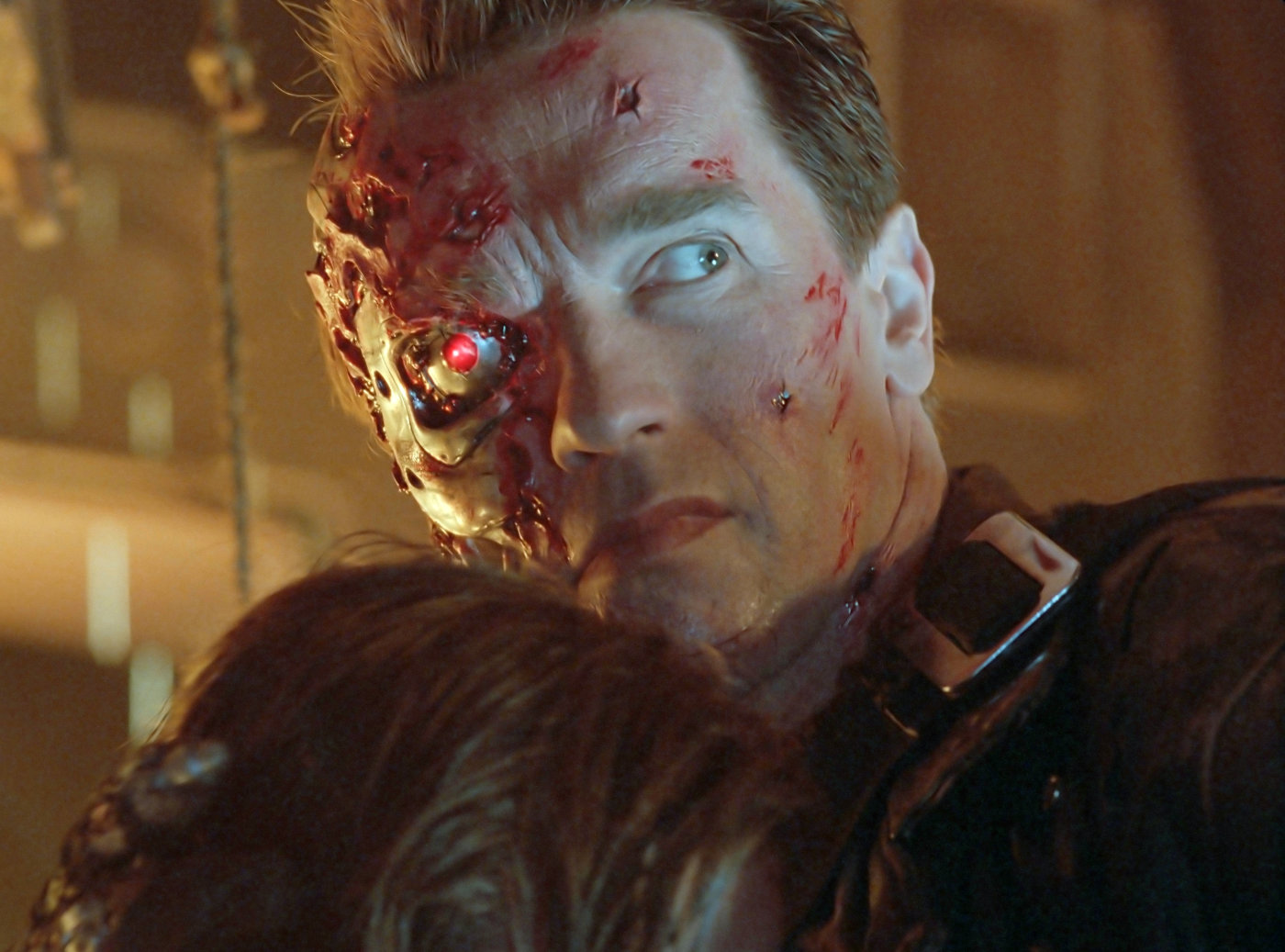
The damaged face helps clarify that argument. Becoming worthy of grief does not require the machine to look convincingly human. Its significance lies in the relationship and the conduct that have developed around it. Conversely, being biologically human has not spared Sarah the danger of treating someone as an object.
The future is an ethical question
This is a reading of the 1991 film, not a claim that every later installment confirms a permanently safe future. The hope we find here is narrower and more demanding: people can interrupt habits that make catastrophe imaginable.
John restricts a weapon. Sarah stops herself. Dyson becomes able to help. Their choices do not make power disappear, but they change what power is permitted to do. That is why the goodbye matters beyond its sadness. The film asks whether humanity can learn restraint before its machines inherit the absence of it.
Join the conversation
What did you think of the ending? Share your interpretation. Spoilers may appear below.
This product uses the TMDB API but is not endorsed or certified by TMDB.
No comments yet. Start the conversation.