

RECAPRUSH MOVIE GUIDE
Inside Out 2 (2024)
Directed by Kelsey Mann
New emotions disrupt thirteen-year-old Riley’s Headquarters as hockey camp and an approaching change of schools test her friendships and sense of identity.
Overview, poster, and credits from TMDB.
Read and watch our full recap ↓FROM THE RECAPRUSH LIBRARY · FULL RECAP
Inside Out 2 (2024) Recap & Ending Explained: Riley Is More Than Her Best Self
13 min read · Estimated reading time— views
Intro + RecapRush Viewpoint
The frightening possibility in Inside Out 2 is that wanting the best for someone can become a way of refusing to know them. Joy wants Riley to remain a good, happy person. Anxiety wants her to be prepared for whatever comes next. Neither intention sounds cruel. The trouble begins when either emotion treats a version of Riley as a project to perfect.
The RecapRush viewpoint: growing up here means becoming harder to summarize. Riley needs a self that can survive a mistake, an awkward introduction and an uncertain future without requiring her to pretend those experiences never happened. The film’s emotional achievement is to make that more complicated identity feel like a source of relief.
This full-spoiler article covers the released 2024 Pixar sequel, including its credits scenes. Factual recap and original RecapRush interpretation are identified separately. The mind-world is the film’s storytelling metaphor, not a literal diagram of how a person’s brain works.
Featured Image

Table of Contents
Quick Facts
- Official title / year: Inside Out 2 / 2024
- Director: Kelsey Mann
- Screenplay: Meg LeFauve and Dave Holstein
- Original story: Meg LeFauve and Kelsey Mann
- Producer / studio: Mark Nielsen / Pixar Animation Studios
- US theatrical release: June 14, 2024
- Runtime / US rating: 96 minutes / PG
- Genres: animation, adventure, comedy and family; a coming-of-age story
- Collection position: #12 in RecapRush’s fixed October 29, 2026 Worldwide lifetime box-office snapshot, separate from the weekly domestic chart
The US opening and 96-minute runtime follow Disney’s official film page. Some catalogues use different territorial dates or round the running time differently. The screenplay supplies the story and screenplay credits; Wikidata independently confirms the TMDB identity. No current gross figure is displayed here. [1–4, 7, 9]
Full Spoiler Recap
1. A familiar mind enters unfamiliar territory
Thirteen-year-old Riley attends hockey camp with Bree and Grace, hoping to impress the Fire Hawks. Learning that her friends will attend a different high school unsettles her. Inside Headquarters, puberty brings renovations and new emotions: Anxiety, Envy, Embarrassment and Ennui. Joy has been protecting Riley’s positive self-image by sending unpleasant memories away. Anxiety instead prioritizes future acceptance, especially with admired older player Val Ortiz. [5]
2. Anxiety takes over the future
Riley’s efforts to fit in distance her from Bree and Grace. Anxiety discards the existing Sense of Self and banishes the original emotions to the Vault. Joy and her companions escape with help from the imaginary characters imprisoned there, including Bloofy and Pouchy. Joy insists on recovering the discarded self; Sadness returns separately to Headquarters, where Embarrassment helps conceal her. [5]

3. A provisional judgment becomes a verdict
Anxiety presses Riley to inspect Coach Roberts’s notebook. Its assessment that she is not ready becomes fuel for greater pressure. Riley trains harder and tries to secure her place with the older players. Meanwhile, Joy’s group encounters Anxiety’s worst-case projections in Imagination Land. The journey ultimately brings them to the mountain of memories Joy had removed. Anxiety destroys their recall route, leaving them stranded. [6]
4. The penalty box brings both stories together
During the scrimmage, Riley becomes consumed by proving herself. She collides with Grace and receives a penalty. Anxiety’s new Sense of Self expresses inadequacy rather than confidence; Riley experiences a panic attack. Joy’s group uses an explosion to ride the discarded memories back toward Headquarters. Those memories enter the Belief System instead of remaining excluded. Joy finds Anxiety overwhelmed at the console and persuades her to release control. [6]
5. Returning to the old Riley is not enough
Restoring the original Sense of Self does not resolve the crisis. Joy lets that version go too, allowing a more complex self to emerge from the full range of Riley’s memories. The emotions embrace it. Riley settles, apologizes to Bree and Grace and returns to the game. Later, she has connections with the Fire Hawks while retaining her old friendships. The final email and smile suggest encouraging news about recruitment; the message itself is not displayed. [7]
Cast + TMDB
Cast and Characters










The following voices belong to Inside Out 2 (2024). In particular, Tony Hale voices Fear and Liza Lapira voices Disgust in this sequel. [1, 3]
Additional principal human characters include Lilimar as Valentina “Val” Ortiz, Grace Lu as Grace and Sumayyah Nuriddin-Green as Bree. Exact TMDB record: https://www.themoviedb.org/movie/1022789 [3]
Pixar’s own character descriptions establish the contrast between Joy’s desire to preserve Riley and Anxiety’s desire to prepare her. That gives the conflict a more interesting starting point than a simple contest between a nice emotion and a nasty one. Both understand themselves as working on Riley’s behalf. [2]
Ending Explained
Why the first Sense of Self cannot simply be put back
RecapRush interpretation: returning to an earlier identity would be an appealing answer if the only problem were an intruder. But Riley’s experience has changed. A self assembled from her nicest memories cannot fully account for the person who has just hurt a friend, wanted approval and discovered conflicting loyalties.
That does not make the earlier Riley a lie. It makes her an incomplete account. The ending gives kindness room to coexist with selfishness and courage room to coexist with fear. Those tensions need not cancel each other out. A person can recognize an unkind action without treating it as proof that every kind action was fraudulent.
This is the difference between a self that must be defended and a self that can learn. The first needs contradictory evidence removed; the second can receive it and still continue. In our reading, Joy’s hardest act is trusting Riley enough to stop maintaining the flattering edit.
Why Anxiety remains part of Headquarters
RecapRush interpretation: an ending that expelled Anxiety would preserve the same logic that caused the crisis: an inconvenient part of Riley would be declared incompatible with the person she ought to be. The more demanding resolution is a change in authority. Concern about tomorrow can contribute without determining the meaning of everything that happens today.
Anxiety’s mistake is to make certainty seem like a condition of safety. There is always another possible rejection to anticipate, so her project cannot finish on its own terms. The film’s answer allows uncertainty to remain. Riley can take part in a game, a friendship and a new school year without first securing a guarantee that she will never be disappointed.
This is a reading of the character’s role in the story, not a clinical explanation or treatment claim. The film’s conclusion is emotional coexistence rather than the promise that difficult feelings have been permanently removed.
Did Riley make the Fire Hawks?
The last beat gives her a new email and a small smile without showing the selection message. It is reasonable to read that as hopeful, possibly successful news; a roster position or the email’s exact wording would go beyond what the ending supplies. The official screenplay describes the same withheld message. [7]
RecapRush interpretation: leaving the result partly outside the audience’s view shifts the weight of the ending. Making the team may matter deeply to Riley, but it no longer needs to carry the whole burden of proving that she deserves a future. The story has already delivered its more consequential change before the notification arrives.
Deep Analysis & Key Themes
1. Joy and Anxiety share an editorial habit
RecapRush interpretation: their apparent opposition can conceal a resemblance. One prefers an account of Riley organized around what should be preserved; the other prefers one organized around what must be prevented. Either approach can turn experience into material to be sorted before Riley is allowed to understand it.
More from RecapRush
 Spider-Man: Brand New Day (2026) Recap & Ending Explained: Why Peter Chooses to Be Known Again
 Coyote vs. Acme (2026) Recap & Ending Explained: Why Wile E. Has to Lose
 Avatar (2009) Recap & Ending Explained: Why Jake’s Final Awakening Is a Commitment
The problem is not simply that one chooses pleasant memories and the other frightening predictions. Both can make their preferred selection stand in for the whole person. Their protective intentions become restrictive when they cannot tolerate evidence that falls outside the assigned story.
This makes Joy’s change substantial. She does more than regain a position at the console. She revises the terms on which she deserves that position. Caring for Riley must include trusting that her life will contain meanings Joy has not approved in advance.
2. The coach’s judgment is smaller than Riley’s fear of it
RecapRush interpretation: a coach can assess readiness for a particular team. That is a bounded judgment about performance at a moment in time. The anxious interpretation expands it into a judgment about whether Riley will have friends, belong at school or be enough as a person.
The distance between those two meanings is where the drama lives. A disappointing assessment can be important without being total. The film lets us see how a limited piece of information acquires enormous emotional jurisdiction when it arrives inside an already frightening story about the future.
The coach therefore need not become a secret villain to make the sequence hurt. The gap between an adult’s working assessment and a young person’s interpretation is sufficient. Riley is answering a much larger question than the notebook was written to address.
3. Friendship becomes difficult when it is treated as insurance
RecapRush interpretation: wanting new friends is not itself a betrayal. The painful change comes when friendship becomes a strategy for preventing future loneliness. Other people then risk becoming credentials: evidence that Riley has secured the correct place in a social order.
That framing also changes what an old friendship feels like. Familiarity can begin to look like a liability if it reveals an identity the person is trying to outgrow. The result is an exhausting performance in which Riley must monitor who knows which version of her.
Her apology matters because it returns the relationship to particular people. Bree and Grace have been hurt; they are not merely symbols of a childhood she must either abandon or preserve unchanged. Repair begins with acknowledging their experience rather than explaining how stressful Riley’s own experience has been.
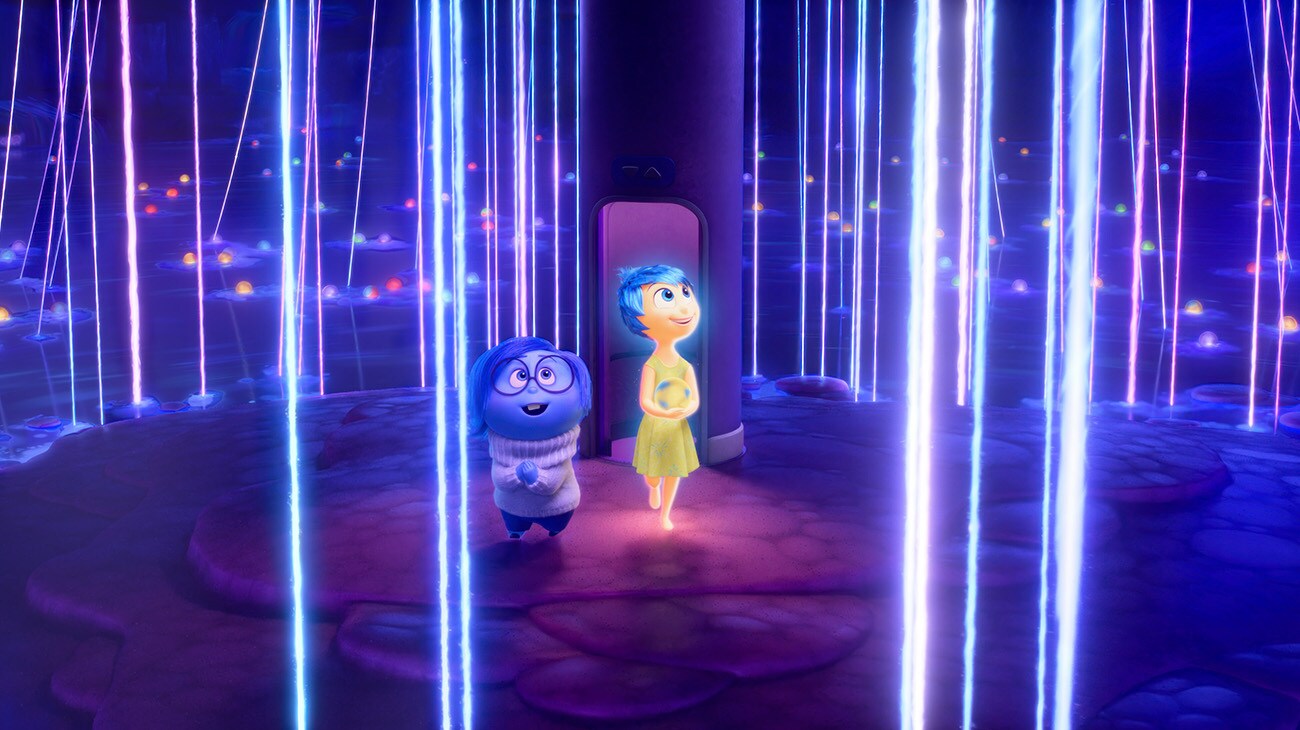
4. The Belief System turns a claim into something tangible
RecapRush interpretation: a belief can feel like a private description while operating like a rule. Once a person believes they are a certain kind of person, an ordinary choice may become a test of whether that description will survive.
The visual system gives the audience a way to distinguish memories from the conclusions drawn from them. Those are not identical things. The same uncomfortable experience can support several possible understandings, especially when it is considered alongside experiences that complicate it.
Read this way, the final self is less like a new slogan and more like a different relationship to evidence. It has room for disagreement within it. Its strength comes from not requiring every remembered moment to testify in the same direction.
5. The crisis changes scale without changing location
Director Kelsey Mann discussed the difficulty of aligning the mind-world climax with Riley’s experience in the penalty box. The filmmakers experimented with the sequence’s structure and visual intensity to maintain that emotional connection. [8]
RecapRush interpretation: the contrast of scale is what makes the sequence effective. Inside Riley, the situation has the urgency of an enormous disaster. Outside, a young player is sitting beside a rink. The ordinary setting does not invalidate the intensity of the inner experience; it asks the audience to notice how much can be happening in a moment that looks small from a distance.
The sequence also changes what action means. Earlier movement promises progress: run farther, train harder, reach the destination. At the climax, more frantic activity cannot supply the answer. The story needs a different relationship to control rather than a larger quantity of effort.
6. Joy can be invited rather than imposed
RecapRush interpretation: there is a meaningful difference between enjoying an activity and demanding enjoyment as proof that everything is fine. An insistence on happiness can make ordinary discomfort feel like another failure to manage.
The ending offers another possibility. Pleasure can return without being used to erase the difficult experience that preceded it. A repaired friendship and a renewed game need not certify that Riley will always feel confident again. They can simply be things she is able to participate in now.
That makes the title’s inward journey more than an explanation for her outward behavior. It becomes an argument for allowing a person some complexity before deciding what their reaction must mean.

What Most Viewers Missed
These are interpretive points for a second viewing, not claims about concealed production intentions.
- The two protective strategies can be compared before either is judged. Ask what Joy and Anxiety each believe would count as evidence that Riley is safe. Their answers reveal why neither can supply a whole identity alone.
- Embarrassment is more than an obstacle. His help for Sadness complicates the assumption that the newer emotions form one united opposing team. That detail is part of the verified plot, not a hypothetical alternate ending. [6]
- Belonging and resemblance are different goals. Riley’s efforts can be read through the question of whether becoming more like admired people actually makes a relationship with them more honest.
- The final result is deliberately less explicit than the emotional resolution. Reading the phone notification as the sole payoff would restore the very hierarchy of importance that the ending has questioned.
- The film’s metaphor works best as an invitation to curiosity. Labeling a reaction may help a viewer discuss it, but the characters should not be mistaken for a complete explanation of any real individual.
Mid/Post-Credits
During the credits, Riley gives her parents a brief, casual account of camp while their own internal reactions suggest much more concern. After the credits, Joy visits Deep Dark Secret in the Vault. His confession concerns burning a hole in a rug; Joy mentions a different embarrassing incident involving a swimming pool, and he retreats again. These are comic codas, not the revelation of a new antagonist. [7]
RecapRush interpretation: both jokes depend on a difference between outward scale and inward importance. A short answer can conceal a complicated weekend; a private embarrassment can feel enormous to the person carrying it. The film ends by making that gap funny after making it moving.
Final Thoughts
Inside Out 2 gives Riley something more useful than a spotless account of herself. It allows her to remain worthy of friendship while admitting that she has behaved badly, and to care about an opportunity without making success the condition of her worth.
The most persuasive reading of its ending is therefore not that Joy defeats Anxiety. It is that caring for Riley requires both to accept limits on their authority. She is allowed to become someone neither of them could have designed alone.
Join the conversation
What did you think of the ending? Share your interpretation. Spoilers may appear below.
This product uses the TMDB API but is not endorsed or certified by TMDB.
No comments yet. Start the conversation.